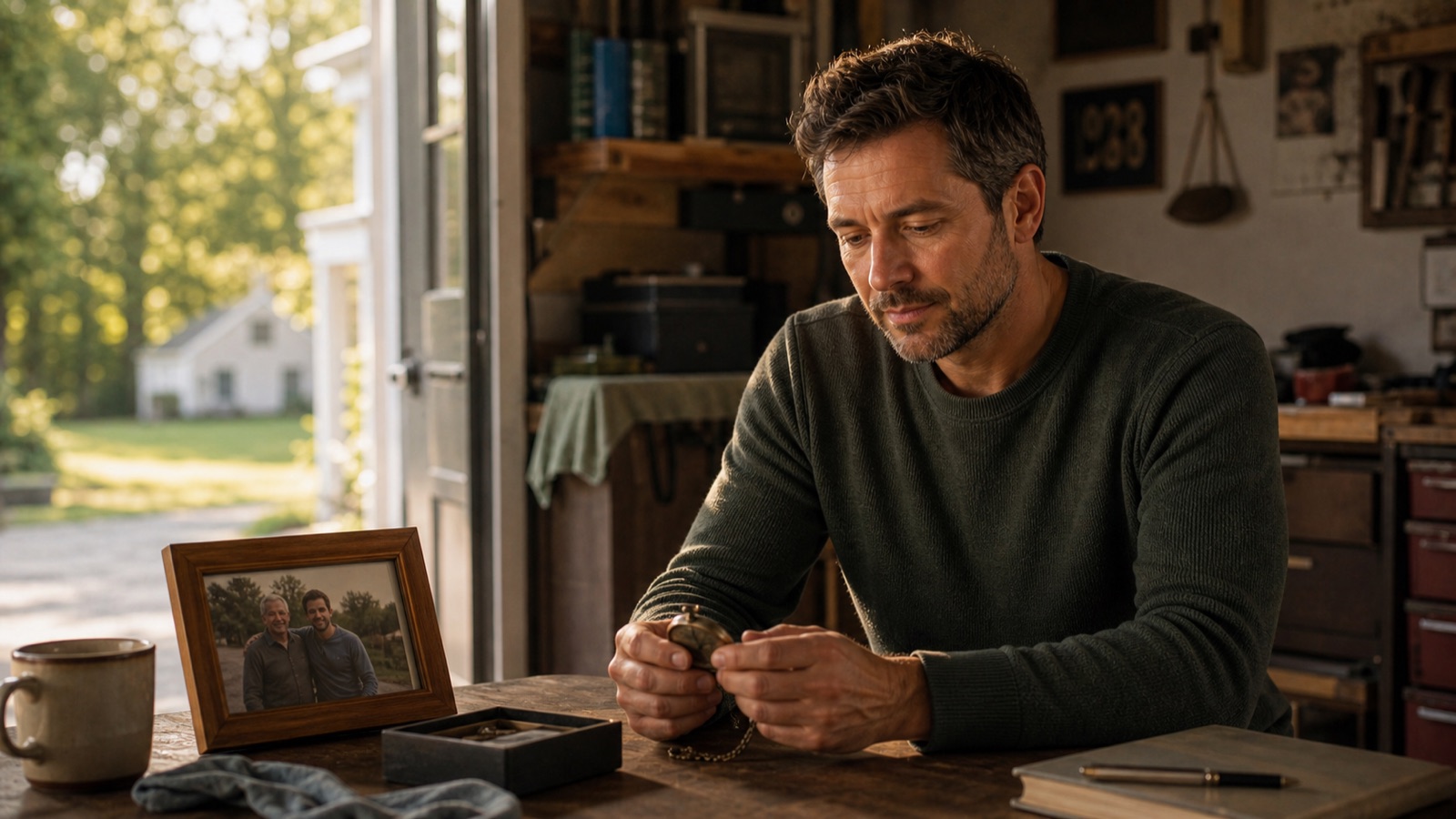
You didn’t fall apart when he died. You organised the funeral, made the calls, held it together for your mum, drove home, went back to work on Wednesday. People told you how strong you were. You accepted that. What else were you going to do with it?
That was six years ago. You haven’t cried since. And somewhere in the back of your head, in the quiet moments you don’t let last too long, you wonder if something is wrong with you.
Nothing is wrong with you. But something did happen — and it didn’t go away. It went underground.
Where it goes instead
Grief gone underground doesn’t announce itself. It doesn’t arrive as sadness you can point to and name. It arrives as a shorter fuse than you used to have. A restlessness that sits behind your eyes. A drinking habit that crept up on you the year after your friend died — and you only made that connection just now, reading this sentence. It arrives as a marriage that ended and a man who ‘got on with it’ so efficiently that he never stopped to ask what he actually lost. It arrives as years of low-grade numbness that you’ve called being fine.
This is what grief does when it has nowhere to go. It doesn’t dissolve. It doesn’t wait patiently for you to be ready. It travels. It moves into the body, into behaviour, into the way you respond to things that seem unrelated but aren’t. The technical term is delayed grief. The lived experience is just: something is slightly off, and you can’t say what.
Why men end up here
There’s a reason men end up here more than they should. And it’s not that men feel less.
From early on, the emotional permissions narrow. Crying as a boy is embarrassing. Crying as a teenager is dangerous. By the time you’re a man standing at a graveside, the unspoken instruction is clear: hold it. Be the one who holds it. Strength, in the version most men inherited, means not needing anything from anyone — and grief is pure need. It is the most naked form of love, the acknowledgment that something mattered so much that its absence is physically real. That is not a comfortable thing to be in public with if you have spent thirty years being told that comfort with vulnerability makes you soft.
This is what grief does when it has nowhere to go. It doesn’t dissolve. It doesn’t wait patiently for you to be ready. It travels. It moves into the body, into behaviour, into the way you respond to things that seem unrelated but aren’t.
So the grief doesn’t get expressed. And unexpressed emotion doesn’t file itself away neatly. It looks for another door.
The door it finds most often
Anger is the door it finds most often.
Anger is the one emotional state that was never fully revoked. Frustration, aggression, edge — these were always permitted, even admired. What nobody told you was that anger is often a cover story. The anger is real, felt in the body. But underneath it, something softer. Hurt. Loss. The devastation of a father who died before you ever sorted things out with him. The grief that has no clean object — not just the death, but the reconciliation that will now never happen.
Men tend to respond to emotional constriction in one of three ways: they fight (the anger that is always close to the surface), they check out (the withdrawal, the going-through-motions, the quietly absent husband or friend), or they numb (the drinking, the working, the screen, the anything that keeps the channel busy enough that the signal doesn’t get through). These are adaptations. They made sense at some point. The problem is that none of them move the grief. They just keep it from surfacing.
anger is often a cover story
The man drinking a bit too much has a reason. He may not know the reason. He may have framed it as stress, or habit, or just what blokes do. But if you trace it back — if you honestly sit with the question of when it started and what was happening then — there’s often something there. A loss. A moment when the floor shifted and no one asked if he was okay, and he didn’t ask himself either.
What grief actually needs
Here’s what grief actually needs in order to move: a witness.
This is the part that no amount of private suffering can replace. Grief processed completely alone tends not to be processed at all — it gets managed, held at arm’s length, survived. Something in the way humans are built requires another person to be present, to acknowledge what happened, to sit with you in the weight of it without trying to fix it or speed it up or tell you he’s in a better place now. The absence of that witness is often why the grief went underground in the first place — because no one created the conditions for it to be anything else, not because you were weak.
And this is the quiet tragedy of the cultural instruction to be strong: it doesn’t just prevent men from grieving in the moment. It prevents them from recognising, years later, that they are still grieving.
The man who hasn’t cried in six years doesn’t think of himself as a man in grief. He thinks of himself as a man who has moved on. The drinking, the irritability, the low warmth — he’d give you a dozen explanations for each of those before he’d land on: I never processed losing my father.
The one thing worth doing
The one thing worth doing — not a list, one thing — is to ask yourself honestly what you buried and when.
The man who hasn’t cried in six years doesn’t think of himself as a man in grief. He thinks of himself as a man who has moved on.
Not in a therapy-exercise way. Just honestly. Think back over the last decade. The deaths, yes. But also the marriage that ended. The career that didn’t work out the way it was supposed to. The version of yourself you quietly abandoned somewhere in your thirties. The friendship that dissolved without a conversation. Any significant loss — of a person, a future, an identity — can leave grief behind. And if it never got named, never got witnessed, it is almost certainly still there in some form.
You don’t have to do anything with the answer immediately. But you do have to be willing to look at it honestly. The behaviour that’s been filling the gap — whatever it is — will keep filling it until the underlying thing has somewhere else to go.
The question worth sitting with is not whether you’ve been strong enough.
You’ve been strong enough. The evidence is that you’re still standing. The real question is whether what you’ve been calling strength is actually distance — and what you might find if you closed some of it.
That’s not a question this article can answer for you. It’s barely a question you can answer right now. But it’s the right question. And the fact that you’re asking it, even quietly, even just by reading this far, means something has started to shift.
The real question is whether what you’ve been calling strength is actually distance — and what you might find if you closed some of it.
What you do with that is yours.