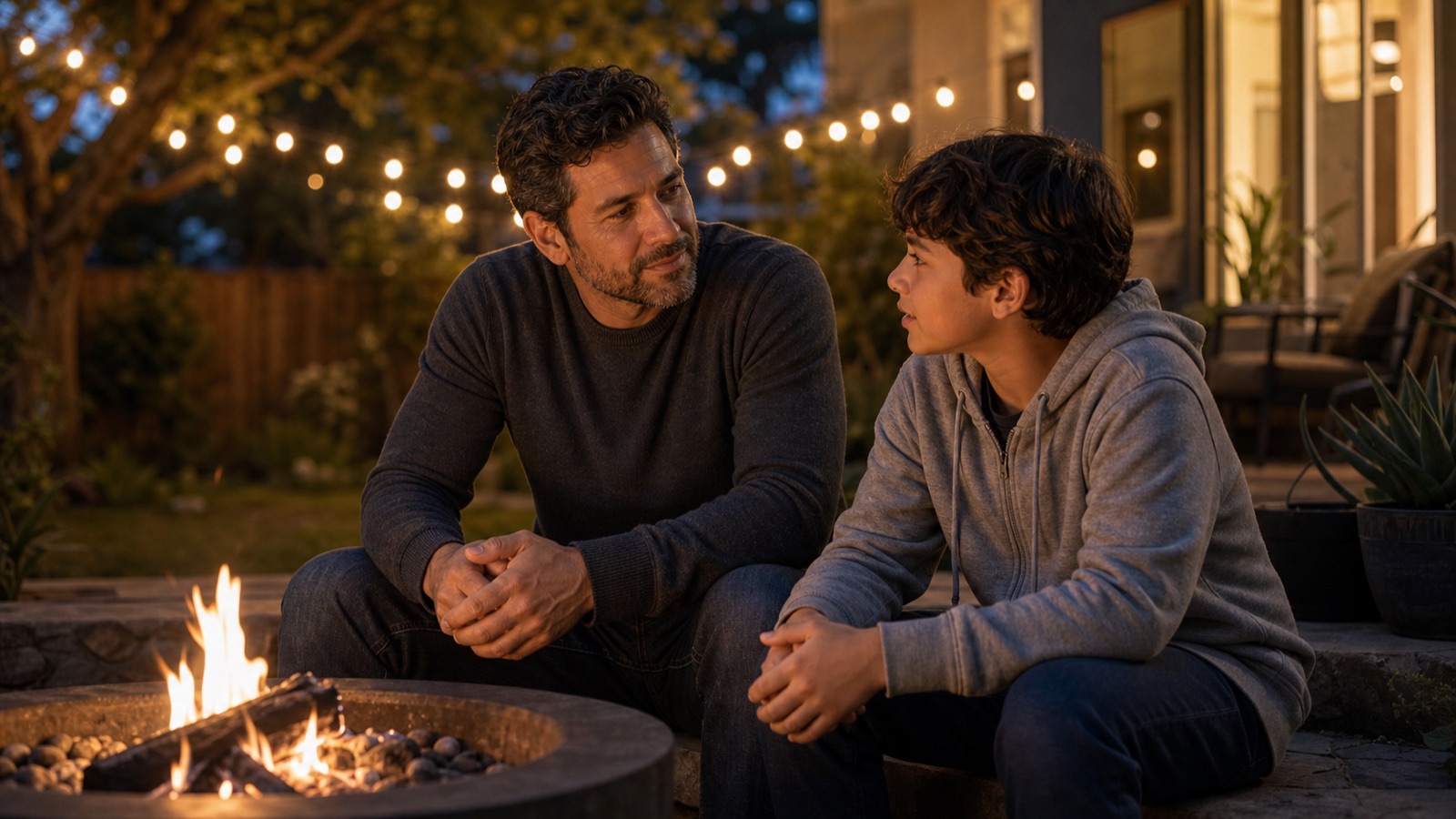
Something With No Obvious Home
There is a specific moment — and if you have children, you have felt it — where your kid does something they couldn’t do six months ago, and your first response is pride. Clean pride. The best version of it. They tied their own shoes. They stood at the edge of the pool and jumped without being asked. They walked into school without looking back at you. You feel it rise in your chest exactly as it should. And then, almost immediately, something else arrives. Quieter. Heavier. Something with no obvious home in a moment that was supposed to be entirely good.
Most men swallow it fast. The cognitive math doesn’t add up: your child is healthy, developing, doing exactly what they’re supposed to do. You should be grateful, full stop. So you choose grateful. You push the other thing down. You take the photograph and tell them you’re proud. Then the next milestone comes — first sleepover, first friend who matters more than you do, first time they solve a problem without asking — and the same thing arrives again. Quietly. Without permission.
That thing has a name. It is grief. Specifically: the grief of time. The grief of something real finishing, not something going wrong. You are not unravelling. You are not failing at gratitude. You are doing exactly what you are supposed to do — feeling the full weight of something you were fully present for.
There Is No Cultural Container for It
The shape of this is difficult to talk about because there is no cultural container for it. Men are not offered much grief to begin with — not male grief with its particular quality, the kind that lives in certain pieces of music and certain last pages of certain books. The world that shaped most men is largely indifferent to that register. It wants movement, resolution, usefulness. It does not want a man sitting with the knowledge that his child’s first three years are gone. Permanently. That those Sunday mornings are not coming back. That the version of his daughter who mispronounced his name in a specific way — who ran a specific run, laughed a specific laugh — no longer exists, and that the child who has replaced her is wonderful in every measurable sense, and is also not her.
Men are offered no vocabulary for this. The closest culturally available container is nostalgia, which is warm and soft and does not carry the actual weight of the thing. This is not nostalgia. Nostalgia has warmth but no edge. What a father feels watching his child grow and recede is sharper than that.
The Same Feeling
The reason pride and devastation arrive together is not a malfunction. They are not two competing feelings. They are the same feeling.
Nostalgia has warmth but no edge. What a father feels watching his child grow and recede is sharper than that.
Grief and love are the same emotion expressed in different directions. The love moves forward — toward the child, toward who they are becoming, toward the future you want for them. The grief moves backward — toward what already happened and cannot unhappen, toward the versions of them you held and watched and followed around the house on slow Saturday mornings. They are the same love. The pride is the love looking forward. The devastation is the love looking at what is permanently behind you.
This is why the intensity spikes at milestones. A birthday party is not just a celebration — it is an annual measurement of distance. Every candle is a year that will not come back. The father in the back of the room, quietly undone while everyone else eats cake, is not experiencing a failure of perspective. He is experiencing what presence costs. He paid attention. He was there. And now the accounts of what he attended are permanently closed.
Grief and love are the same emotion expressed in different directions.
I Missed You. And I Had Fun.
There is a small story worth sitting with. A child — maybe three years old — was being raised by parents who worked to name things carefully. When they came home from an evening out, they asked the boy how his time had been. He said: I missed you. And I had fun.
Every candle is a year that will not come back.
Both. At the same time. Without resolving the tension or choosing one.
A three-year-old can hold this. Adults work hard to avoid it. Men especially. The drive to resolve — to pick the feeling that makes the most sense in the moment — is strong. Celebration calls for celebration feelings. So grief gets filed away unlabelled, reappearing later as a mood that can’t be sourced, an irritability that makes no sense, a flatness after events that were supposed to feel good.
Holding pride and devastation simultaneously is the more sophisticated position, not weakness. The man who can say, out loud or just to himself — I am proud and I am heartbroken, and both of those are true right now — is more awake to his actual experience than the man who has tidied it into something easier.
No Lesson Extractable
There is another pressure operating beyond the personal. The cultural grammar around grief — and around fatherhood — runs on redemption arcs. The expected shape is: something difficult happens, you go through it, you emerge stronger, you find the gift in it. Films, social feeds, the conversations at birthday parties — all of it pulls toward this structure. Loss becomes lesson. Difficulty becomes character development. The acceptable version of a grieving father is one who uses it.
Fatherhood grief does not fit this arc cleanly. There is no lesson extractable from the fact that your daughter is now seven instead of four. There is no gift to find in the specific fact of time passing. The correct response to feeling devastated watching your kid grow is not a pivot to purpose. There is nothing to build. There is no marathon to run. There is just the actual texture of time, and the love that made it land so hard.
Demanding that this grief produce something — meaning, growth, gratitude — is a way of refusing to let it be what it is. A man who feels the devastation and is then told, implicitly, that he needs to process it into something more useful before it counts is being asked to earn his own experience. He doesn’t need to earn it. He already paid for it. He paid for it by being there.
A Father’s Grief Is Proof He Was Paying Attention
A father’s grief is proof he was paying attention.
That is the full sentence. Not proof that something went wrong. Not proof that he is insufficiently grateful for the child who stands in front of him now. Proof that he was present in the stages that are now permanently gone — that he held them, noticed them, let them matter.
You cannot grieve something you did not have. You cannot feel the weight of a version of your child passing if you were not there for it. The devastation is the receipt. It says: you were here. You showed up. This mattered to you. And because it mattered to you, the fact that it is over has weight.
A father’s grief is proof he was paying attention.
This does not require a practice or a ritual or a therapeutic exercise. The one thing worth doing is the simplest: stop swallowing it. Stop filing it under ingratitude and moving past it before it can be felt. Let it arrive when it arrives — at the birthday party, in the back row, looking at a photograph from two years ago where they look completely different. Let it be both things at once. The pride and the grief are not a problem to resolve. They are the shape of a life that was paid attention to.
The Question Underneath All of This
The question underneath all of this — the one that doesn’t have a clean answer — is what it means to stay present with a person you are simultaneously losing, incrementally, continuously, by design.
Because that is what parenting is. The job, done well, ends in your own obsolescence. The child who needed everything from you eventually needs almost none of it. The irreversibility is the goal, not an accident. Every stage of development is a stage of separation, and pride and devastation are the correct response to that process working exactly as it should.
Knowing this does not make it easier. The grief of time does not dissolve once you understand it. What you can do — what this is actually asking of you — is stop treating the devastation as evidence that something has gone wrong with you. Stop asking it to transform into a lesson. Stop requiring it to earn its place.
Whether you can hold both without collapsing one into the other — without making the grief mean something larger so it becomes manageable, without choosing gratitude as a way of not feeling the loss — that is the question only you can answer. And it is a question you will face again. At the next milestone. And the one after that.